Corrosion-resistant, multi-metal joints in electric vehicles (EVs) are designed by removing the conditions galvanic corrosion needs to occur: dissimilar metals in electrical contact, bridged by an electrolyte such as moisture or road salt. Engineers do this through careful material pairing, insulation, coatings, sealing and joint geometry. The challenge is growing because EVs combine more aluminium with copper and steel than conventional vehicles.
Why are multi-metal joints so common in electric vehicles?
Multi-metal joints are common in EVs because lightweighting and electrification push manufacturers to combine aluminium, copper and steel within the same assemblies.
Aluminium offsets battery weight and extends range. According to research by Ducker Carlisle for European Aluminium, a battery electric vehicle produced in Europe in 2022 contained 283 kg of aluminium on average, compared with 169 kg in a petrol or diesel car. Copper remains essential for motors, cabling and busbars, and steel for fasteners and brackets. The result is a vehicle full of dissimilar metal interfaces, many in battery enclosures and underbody areas exposed to water and de-icing salts.
What is galvanic corrosion?
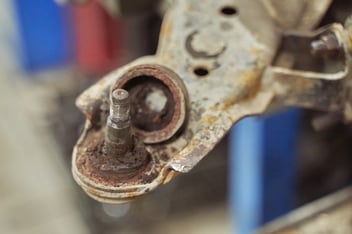
Galvanic corrosion, also called bimetallic corrosion, is the accelerated corrosion of one metal when it is in electrical contact with a more noble metal in the presence of an electrolyte.
The UK’s National Physical Laboratory explains in its guide to bimetallic corrosion that electrons flow from the more reactive metal (the anode) to the more noble metal (the cathode). Three conditions must be present at once: an electrolyte bridging the metals, an electrical connection and a sustained cathodic reaction. Remove any one and galvanic attack is prevented. In EV joints, aluminium is almost always the anode, which means it is the metal that corrodes.
Which metal combinations carry the greatest risk in EVs?
Aluminium paired with copper, steel or stainless steel presents the most common galvanic risks in EVs, though severity depends on environment and relative area.
| Metal pairing | Typical EV location | Key consideration |
| Aluminium and copper | Busbars, battery terminals, cable lugs | Corrosion products raise electrical resistance |
| Aluminium and steel | Subframes, brackets, battery trays | Aluminium corrodes around the steel contact |
| Aluminium and stainless steel | Fasteners and threads in aluminium housings | Risk rises with moisture and large stainless areas |
| Copper and steel | Grounding points, electrical connections | Steel becomes the anode and corrodes |
Area ratio matters as much as material choice. The NPL notes that a large cathode coupled with a small anode intensifies attack, while potential difference alone is a poor predictor: some couples separated by just 50 mV have caused problems, while others with 800 mV between them perform well.
Why does aluminium–copper corrosion matter in battery systems?
Aluminium–copper corrosion matters in battery systems because corrosion products increase contact resistance, raising joint temperatures and reducing electrical efficiency.
A study of hybrid aluminium–copper busbars published in the International Journal of Lightweight Materials and Manufacture found that under salt spray testing, loosely clamped fastened joints saw electrical resistance rise by around two orders of magnitude, while firmly clamped joints limited the increase to roughly 40% over 30 days. Clamp load, and therefore threaded joint integrity, directly influences how these connections age.
How can engineers prevent galvanic corrosion in EV joints?
Engineers can prevent galvanic corrosion by breaking one of its three conditions, and the most robust designs combine several of the following measures:
-
Selecting metals that sit close together in the galvanic series for the expected environment.
-
Isolating dissimilar metals with non-conductive washers, bushes or gaskets.
-
Coating both metals, or the cathode if only one can be coated.
-
Sealing joints to exclude moisture and avoiding geometry that traps water.
-
Avoiding small anodes coupled with large cathodes.
-
Using bimetallic transition pieces or plated interfaces for electrical joints.
What role do threaded joints play in corrosion resistance?
Threaded joints are a frequent weak point because fasteners often introduce a dissimilar metal directly into a lightweight parent material such as aluminium or magnesium.
Threads tapped into aluminium are both the anode and the load-bearing interface, so corrosion can weaken the joint and complicate disassembly. Specifying the right fastener and thread reinforcement materials helps preserve joint strength, as explored in our guide to galvanic corrosion resistance for mechanical joints.
Why is corrosion-resistant joint design a lifetime cost issue?
Corrosion-resistant design is a lifetime cost issue because joint corrosion leads to repair and replacement long after a vehicle leaves the line.
NACE International’s IMPACT study estimated the global cost of corrosion at US$2.5 trillion, roughly 3.4% of global GDP, and found that applying available corrosion control practices could save 15 to 35% of that cost. For EV manufacturers, designing out galvanic risk early protects warranty costs and battery reliability.
How can wire thread inserts help protect multi-metal joints?
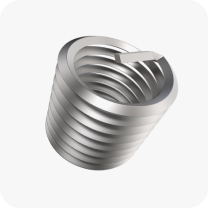
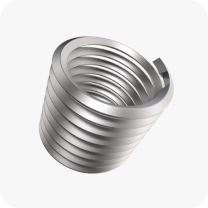
Wire thread inserts help protect multi-metal joints by giving the fastener a strong, hard-wearing thread, instead of relying on a thread cut directly into a soft parent material such as aluminium.
In an EV, aluminium is usually both the anode in the galvanic couple and the load-bearing thread, so corrosion attacks the joint where it is weakest. A wire thread insert strengthens that thread and helps the joint hold its clamp load, which matters in battery connections where loose joints degrade fastest. Inserts can also be made in materials suited to the metal pairing and the environment, so engineers can reduce galvanic risk from the design stage.
Building durability into EV joints
As EVs use more aluminium alongside copper and steel, preventing galvanic corrosion has become a core part of joint design rather than an afterthought. By designing to break the conditions corrosion needs, engineers can create lighter assemblies that stay strong, conductive and serviceable.
KATO Advanex supports manufacturers across automotive, aerospace, marine and electronics with wire thread inserts engineered for demanding, multi-material applications.
.jpg?width=352&name=Shutterstock_1473498770%20(1).jpg)
.jpg?width=352&name=aircraft%20maintenance%20(1).jpg)