

Semiconductor manufacturing is constantly compressing more capability into less space. This applies as much to mechanical features as it does transistor nodes and interconnect layers. The housings, stages, modules, fixtures, precision assemblies and packaging structures all have to be assembled, aligned, serviced and kept stable.
As equipment and electronics become more compact, the joints holding them together need to shrink too without sacrificing important levels of reliability, cleanliness, precision and repeatability. In semiconductor environments, joints can easily become a limiting factor for uptime, yield, contamination control and maintenance efficiency.
The tolerance challenges that come with miniaturisation
In semiconductor production, even the smallest deviations can matter. Tools like lithography scanners, wafer stages and metrology systems depend on solid and stable structures as well as repeatable positioning. When assemblies shrink, engineers lose the luxury of “oversizing” a joint for robustness. Instead, the joint must deliver stability with minimal footprint which pushes designers toward miniaturised fastening features, tighter thread geometry control, and specific technologies that preserve strength in small interfaces.
The role of miniaturised mechanical joints for semiconductor manufacturing
As semiconductor systems become more compact and complex, the demands placed on their mechanical joints change as a result. They are required to solve very specific engineering and manufacturing challenges that emerge as scale, precision and process control tighten.
Higher density systems leave less room for conventional fasteners
Semiconductor tools and electronic modules increasingly pack more functions into smaller envelopes. This includes tighter routing, higher channel density and more compact sub-assemblies. That reduces available space for traditional bolts, thread engagement lengths and fastening clearances. Miniaturised joints let designers maintain assembly integrity without sacrificing functional volume or forcing awkward access for tooling.
Precision alignment need to be maintained across assemblies
The manufacturing processes of semiconductors rely on alignment accuracy and repeatability. Mechanical joints influence alignment because they define clamp force, positional stability and deformation behaviour. When joints are miniaturised well, they can reduce tolerance stack-up and help maintain consistent preload without introducing distortion into delicate or thin structures.
Thermal cycling and vibration punish small interfaces
Semiconductor tools and electronics see frequent thermal changes (process heat, local hotspots, cool-down cycles) as well as continuous vibration from factors like pumps and facility infrastructure. At small scales, these stresses concentrate faster especially in lightweight alloys, thin housings or mixed-material assemblies. A miniaturised joint has to resist loosening, fatigue and wear without relying on “more material” as the safety margin.
Reliability at the small scale
One of the most significant consequences of miniaturised joints is the way reliability margins change. Smaller joints typically mean:
Common challenges include:
- Reduced thread engagement or contact area
- Higher stress concentration in parent materials
- Less tolerance for installation variability or over-torque
- Faster onset of wear or fatigue if loads are uneven
Even minor joint degradation can have disproportionate consequences In semiconductor manufacturing equipment as downtime directly affects yield and throughput. As a result, joint reliability becomes a system-level consideration rather than a fastener-level one.
Semiconductor manufacturing environments place unusual demands on mechanical assemblies.
Cleanliness and maintainability influence joint design choices
The joints used in semiconductor manufacturing need to support clean operation and predictable maintenance. This is because cleanroom control practices (ISO 14644) and equipment maintainability expectations (SEMI E10) are baked into how fabs run and measure tool performance.
In this respect, smaller joints are often preferred because they reduce exposed surfaces that can trap contaminants and allow tighter, more enclosed designs. That said, miniaturisation can also make maintenance more challenging if joints are difficult to access, sensitive to handling, or prone to damage during repeated assembly and disassembly. This creates a design tension between compactness and long-term serviceability that engineers must carefully balance.
Why wire thread inserts make a good fit for semiconductor manufacturing
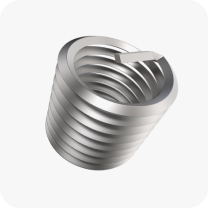
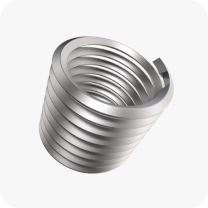
For an application like semiconductors, relying on threads cut directly into lightweight or thin parent materials becomes increasingly risky. This is where wire thread inserts become invaluable by changing how load, wear and variability are managed at the joint interface, without requiring larger fasteners or more material. In practice, wire thread inserts help semiconductor manufacturers by:
-
Preserving joint strength in small footprints, where thread engagement length is limited
-
Distributing load more evenly, reducing stress concentration and deformation in parent materials
-
Maintaining consistent preload and alignment, critical for precision assemblies
-
Improving resistance to thermal cycling and vibration, reducing loosening and fatigue
-
Extending thread life during repeated assembly and maintenance, supporting uptime and serviceability
-
Reducing variability and rework, helping joints perform predictably in controlled manufacturing environments
Designing reliable joints for the future of semiconductor manufacturing
As semiconductor manufacturing continues to push toward smaller, more precise and more complex systems, mechanical joint design becomes increasingly critical. Miniaturised joints need to deliver strength, stability and repeatability without compromising cleanliness or maintainability. Addressing these challenges requires joint solutions that are engineered for reliability at small scales, not simply scaled-down hardware.
KATO Advanex applies decades of experience from aerospace and other high-reliability sectors to help manufacturers meet these demands, supporting compact, precision assemblies that perform consistently throughout their service life.
To find out more about how our wire thread inserts can protect mechanical joints from failure, download our guide below.


.jpg?width=352&name=KATO%20PLANE%20(2).jpg)



.jpg?width=352&name=Shutterstock_1207978306%20(1).jpg)