
Across sectors like aerospace, semiconductors, medical devices and electric vehicles designers are relentlessly challenged to make products smaller, lighter and stronger.
To achieve success, engineers need to balance weight, serviceability and torque integrity to coexist in tighter packages without compromising performance or reliability.
For mechanical joints (the backbone of every assembly) this balance becomes especially delicate. Traditional fastener solutions force engineers to choose between competing priorities. A lightweight joint may lack serviceable strength, a torque-robust connection might add unwanted mass or complexity. That tension is at the heart of why innovative joining solutions like wire thread inserts are increasingly essential in high-performance miniaturised systems.
Understanding trade-offs in miniaturised mechanical joints
Mechanical joints are deceptively simple. They transfer forces, maintain alignment and allow serviceability through assembly and disassembly. But as designers miniaturise assemblies, three core variables come into conflict.
1. Weight vs strength
Lightweight materials such as aluminium, magnesium and advanced composites are key enablers of miniaturisation. However, these materials often have lower shear and tensile strengths compared to traditional steels. Tapping threads directly into these softer substrates risks thread stripping or reduced service life, especially under repeated assembly cycles.
2. Serviceability vs durability
Miniaturised assemblies inevitably reduce access to internal fasteners. Designs prioritising compact size often hide threaded joints in confined spaces, making maintenance or replacement difficult. A solution that makes a joint strong enough to endure repeated torque cycles without damage or deformation directly supports long-term serviceability, yet many traditional fixes fall short as dimensions shrink.
3. Torque control vs reliability
Torque represents the input energy that determines the clamping forge that keeps a joint secure, known as preload. Predictably achieving the right preload in small fasteners is increasingly difficult because frictional losses and material deformation can disproportionately influence joint behaviour. If torque control isn’t reliable, the joint won’t be reliable either, especially under vibration, thermal cycling or high-stress environments.
Wire thread inserts - engineered to balance the trade-offs
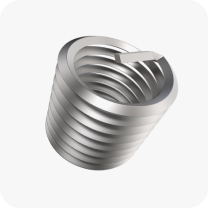
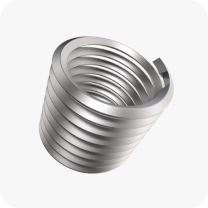
Wire thread inserts (coiled inserts typically made from stainless steel or high-performance alloys) are invaluable for miniaturisation efforts. Unlike traditional approaches where a bolt threads directly into the parent material, a wire thread insert creates a reinforced threaded interface that inherits the best properties of both the fastener and the host material.
Load distribution and strength in light materials
Wire thread inserts expand slightly against the parent material, increasing the effective thread engagement area and evening out stress distribution along the thread length. This reduces peak stress concentrations that would otherwise lead to thread strip-out in softer miniaturised parts. Such reinforcement makes lightweight materials behave more like higher-strength alloys in service.
Predictable torque and preload behaviour
Because wire thread inserts create a consistent, uniform contact profile for mating bolts, they improve preload predictability and torque-to-tension conversion which is critical for maintaining joint integrity in small assemblies. This predictable torque behaviour supports repeatable assembly and disassembly cycles, crucial for serviceability and quality control.
Enhanced serviceability and reusability
Miniaturised designs that demand frequent assembly cycles (whether for maintenance, calibration or upgrades) benefit from the durability offered by wire thread inserts. They protect the parent material threads from wear and deformation, preserving joint integrity even after repeated use. This extends time between maintenance events and supports sustainable product lifecycles.
Weight neutral or even weight saving
Rather than adding bulk, wire thread inserts enable weight reduction. By reinforcing lower-mass components to accept standard fasteners reliably, engineers can avoid heavier alloy fasteners or oversized flanges, which is a win for lightweight design.
Designing joints for the next era of engineering
Miniaturisation is all about optimising design trade-offs so that assemblies are lightweight, serviceable and reliable. Traditional fastening approaches can make that balance difficult, forcing engineers into compromises.
Wire thread inserts offer a way out of that compromise. By reinforcing joints at the thread level, they enable strong preload retention, even load distribution and extended service life all while supporting lightweight materials and compact designs.
KATO Advanex brings decades of aerospace-proven experience to the challenge of miniaturised manufacturing. Our wire thread inserts are engineered to deliver consistent torque, long-term durability and reliable serviceability in lightweight, compact assemblies. With a wide range of Tangless® and tanged inserts, multiple material options and full compliance with aerospace, military and commercial standards, KATO supports engineers designing smaller, stronger and more reliable products without compromise.

.jpg?width=352&name=Shutterstock_285892688%20(1).jpg)

.jpg?width=352&name=Shutterstock_2288877403%20(1).jpg)